
Weekly Wellness Lifestyle Tip – High-tech Fitness Equipment For an Active Longevity
Dr. Kampert, Sports and Exercise Medicine Physician and member of the Wellness Foundation’s Scientific Committee, emphasizes how crucial exercise is in managing and improving various medical conditions.
The medical community is increasingly aware of the fact that physical exercise can be considered a full-fledged medication for a range of chronic diseases, as well as a powerful ally for living longer, more actively, from a young age.
Dr Matthew Kampert, a sports medicine and endocrinology physician from world-leading healthcare and academic research institutions, underscored how exercise serves as an efficient medicine for a series of medical conditions.
Kampert is also a member of the Wellness Foundation Scientific Committee. The Wellness Foundation was established in 2003 by Nerio Alessandri – founder of Technogym – as a non-profit organization that supports scientific research and health education.
In the case of diabetes, insulin is used to act on inactive glucose receptors located in muscle cells and fat cells, whose role is to bring the glucose inside the cells. Exercise has been proven to activate these receptors without insulin, which is fundamental for individuals who developed insulin resistance. Dr Kampert also highlighted how exercise is an effective tool to drive glucose towards muscle cells rather than fat cells.
Exercise, in fact, can target most NDCs (non-communicable diseases): obesity, diabetes, hypertension, and other sedentariness-induced conditions. One of the best pathologies to address through physical exercise is sarcopenia, age-induced muscle waste. Exercise is a great protector of lean muscle mass and a powerful stimulus for its growth.
If individuals want to be able to be active when they retire, they have to take good care of their muscle state starting when they’re young. As people get older, it’s physiological to lose muscle mass and it’s harder to build it, so one has to take advantage of the young age to work on muscle and bone density through resistance training (or strength training).
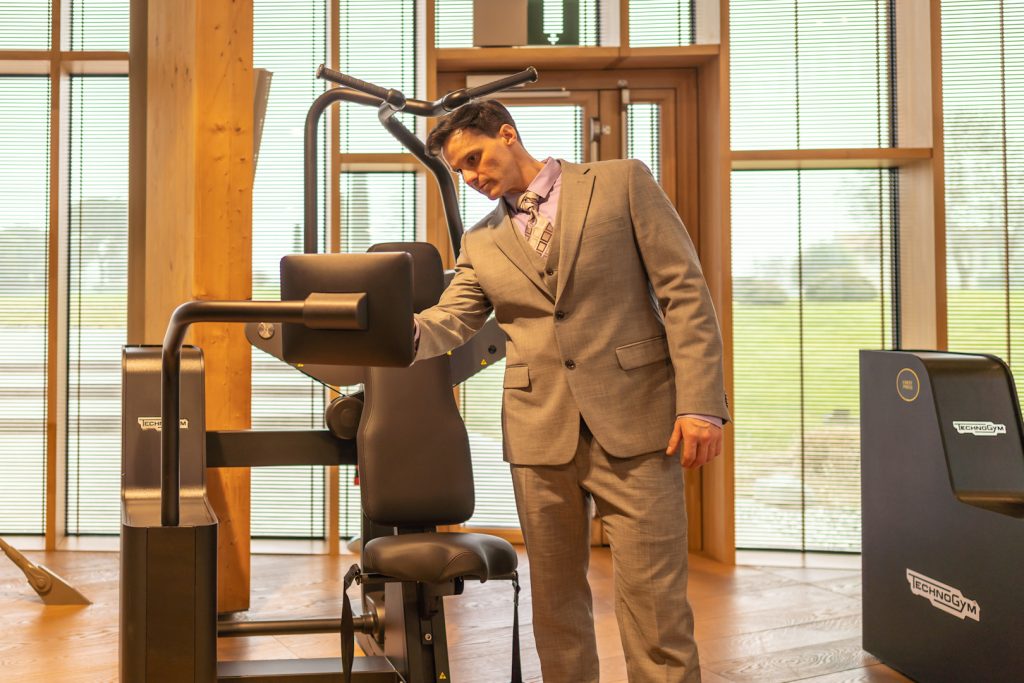
Technogym’s ultimate offering for resistance training and its precision health applications is Biostrength. Biostrength leverages Artificial Intelligence for up to 30% better results in the same amount of time; after the user’s login, the piece of equipment recognizes their profile and specific need (including muscle tone), providing the proper load, range of motion, posture, speed, number of sets, repetitions, and optimal recovery time.
On the other hand, consistent cardiovascular exercise (any activity which requires oxygen to generate energy, making the heart rate raise) makes the heart and circulatory systems more efficient and prolongates longevity, lowering the resting heart rate. It is no coincidence that hearts which, at rest, beat less than 60 times per minute are called sports hearts.
It goes without saying that exercise is also a great component of weight loss dynamics, as it basically increases caloric expenditure. As a matter of fact, it is not as simple as calories in equals calories out, because in caloric surplus some people gain fat, others gain muscle mass. This may depend on genetics and hormones, but mostly on how physically active people are. Being on a calorie-surplus regimen while going for resistance training sessions will result in an increased muscle mass, while sedentariness deposits calories within fat tissue.
Exercise plays a pivotal role in improving body composition, which serves as a better and more precise metric than BMI (Body Mass Index, height/weight ratio) to measure a person’s health and physical state. Often, when an overweight or obese person restricts their calorie intake, they lose both muscle and fat; if they happen to go back to the old unhealthy eating habits, they’ll gain fat mass only, and they’ll end up with less muscle (sarcopenic obesity). This is why incorporating resistance training in the weight-loss process is fundamental. This becomes increasingly important when creating a caloric deficient through the use of anti-obesity medications or surgery, because over 1/3 of the weight lost can come from lean muscle mass if resistance-based exercise is not appropriately prescribed to this population.
Essentially, not including resistance training in one’s gym sessions can be dangerous, as there’s just a certain amount of time when one can effectively gain muscle and bone density. Missing this opportunity may lead to osteopenia and osteoporosis as well. Working on bones and muscle improves the quality of life, as longevity doesn’t only mean living longer, but also living better and more actively.
Technogym’s high-tech solutions for clinical centers
At advanced clinical centers, exercise medicine is a reality, data and technology need to be leveraged to maximize the usage of exercise equipment. Technogym’s Mywellness cloud platform enables the delivery of a precise data-driven exercise prescription, with the ability to control and monitor exercise intensity. It makes up the first cloud computing technology in the fitness industry and represents a priceless asset for operators of the medical sector.
With smart gym technology, patients can train with the equipment independently, seeing the physician just when needed. Technogym’s connected ecosystem of data and smart equipment enables the medical team to assess the patient, to provide an individualized exercise prescription and to monitor and track their medical and fitness outcomes.
Leveraging such equipment and digital solutions, clinical centers can create programs in which the medical team works with patients to develop an exercise regimen that meets their health goals. The patient’s experience starts with their primary care physician, who may refer them to a specialist for medical optimization and clearance for exercise. The specialist and patient work together to develop an exercise regimen that meets their health goals.
An exercise physiologist functions a physician extender by conducting exercise assessments for cardiorespiratory fitness, and 1 rep maximal isokinetic strength testing for each major muscle group. The exercise physiologists will then guide the patient through their workout, and the patient can return to the facility to exercise independently. When they check in at the kiosk, it directs them to the appropriate exercise machines. The machines adjust seat, range of motion and resistance accordingly, and they say how long or how many reps for each exercise. Every moment of the workout is recorded, including heart rate and how patients perform. This data is then available to physicians and specialists, enhancing their clinical documentation, as they can then review this information and adjust prescribed exercise to improve patient outcomes.
The Member App allows patients to stay connected to the care team, no matter where they exercise. This innovative application of technology will undoubtedly help lead the way in exercise medicine and deliver the highest-quality care. Dr Kampert states that as medical providers it is their responsibility to educate and train patients to become independent exercisers and together improve the health of communities. Patients’ increased physical fitness will improve surgical outcomes and recovery, and they will have developed healthy habits for a lifetime.
“Prescribing a diet and exercise regimen should be similar to prescribing medication,” says Dr Kampert. “Patients need the right dose of the right type of exercise – including stretching, resistance training, cardio training and recovery period – with the right fuel at the right time,” he adds.
–Article brought to you by TechnoGym