
Nutrition Highlight: Nutrients that Can Help Boost your Immune System During Winter
Nutrients that Can Help Boost your Immune System During the Winter Months
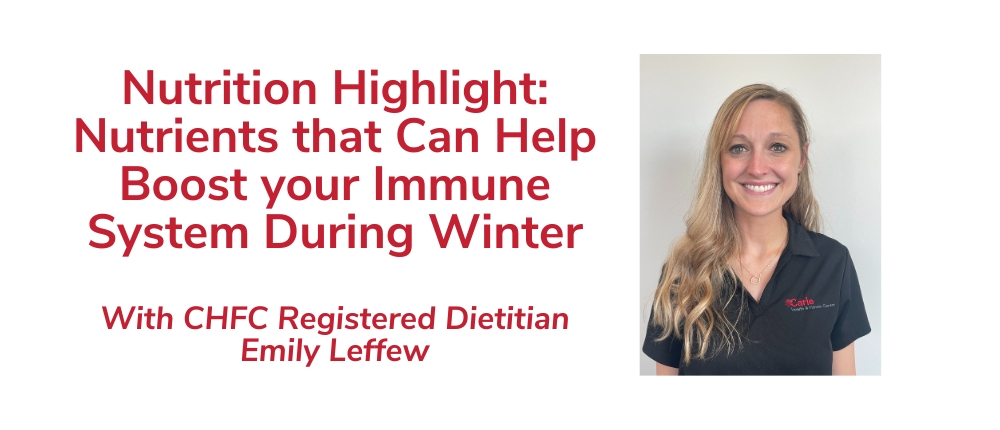
Presented by CHFC Registered Dietitian Emily Leffew
The specific nutrients that are best known to help support the immune system are Vitamin C, zinc and Vitamin D. These are important because they support the growth of immune cells. They enhance their function and they contribute to the production of antibodies. Deficiencies in these nutrients can actually weaken immunity and increase our risk of infection.
Vitamin C is the most well known nutrient that helps support the immune system. Food sources of Vitamin C include oranges, red and green peppers, kiwi, broccoli, strawberries, and Brussels sprouts. Orange juice, grapefruit juice, and tomato juice are also excellent sources of Vitamin C.
Food sources of zinc include meat, fish, and seafood. Oysters contain more zinc per serving than any other food, but beef is the biggest contributor in the United States because it is more commonly consumed eggs. Dairy products, beans, nuts, and whole grains are also good sources of zinc.
Vitamin D is found naturally in a few foods such as trout, salmon, tuna, mushrooms, cow’s milk, eggs and cheese. In American diets, fortified foods such as milk and breakfast cereals provide most of the Vitamin D that is consumed.
Supplements
A lot of people use supplements like emergency or airborne during the winter months to help keep us from getting sick or to help us get over an illness quicker. Supplements can certainly have a benefit, but we want be careful that we’re not going past the upper limit for nutrients, like vitamins and minerals. There is an established upper limit for what’s considered safe. We want to make sure that we’re staying below this limit so as to not have adverse health effects.
The upper limit for Vitamin C is 2000 milligrams per day. Vitamin C is a water soluble vitamin, which means we don’t store it in excess amounts in the body. If we consume more than what we need, we actually excrete it in the urine when we go to the bathroom.
The upper limit for zinc is 40 milligrams per day. This is also a nutrient that we don’t store in large quantities, so it is hard to get too much of. The upper limit for Vitamin D is 100 micrograms or 4,000 international units per day.
Excess amounts of Vitamin D can be harmful because Vitamin D is a fat soluble nutrient. This means that we store Vitamin D in our body and it can start to build up in excess amounts.
The best way to get nutrients is of course, from food, but supplements can certainly come in handy, especially during the winter month. Supplements can help shorten the duration of an illness like the cold or the flu, and they can also help prevent us from getting sick in the first place. Taking excessive amounts of nutrients for weeks at a time is not recommended and it can even be harmful.
If you have questions about supplements or nutrients to help support the immune system, feel free to stop by the Member Service Desk and schedule a nutrition appointment.