
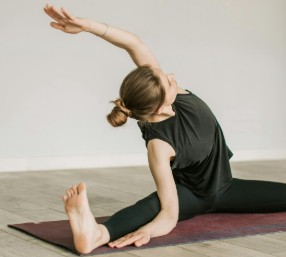
Weekly Wellness Mind Tip – Discover Pilates at home: a gentle introduction to the well-being of body and mind
This article will introduce you to the basics of Pilates, explain its benefits, and guide you through a few simple moves to get you started. By the end, you’ll feel more confident and ready to continue your practice, whether at home or in the studio.
If you are reading this, our best bet is that you have been curious about Pilates, but felt a bit intimidated by the idea of stepping into a studio. You’re not alone. Many beginners share the same feeling, and that’s completely normal. The good news is that Pilates is a wonderful way to improve your strength, flexibility, and overall well-being, and you can start right from the comfort of your own home. So follow us along, roll out your mat, take a deep breath, and let’s begin this journey together: we’ll start off with a short introduction to Pilates, then follow along with a few exercises that you can learn and perform in the comfort of your home.
First of all: what is Pilates, anyway?
Awareness of the link between physical and mental health is quite recent. Someone who did understand this was German-born Joseph Pilates. In the 1920s, Pilates developed a program of body and mind-strengthening exercises aimed at helping injured soldiers and dancers.
In New York in 1926, he opened the first dedicated Pilates studio with a program focusing on six key principles, which are still very much at the heart of Pilates.
- Concentration: focus on each movement and your body’s response to engage muscles fully and develop greater body awareness.
- Control: move consciously to target the correct muscles deliberately and avoid injury, enhancing strength and endurance.
- Centre: activate your core muscles, including abdominals, lower back, hips, and buttocks, to provide a stable base for movement and improve posture.
- Breath: proper breathing oxygenates muscles, regulates heart rate, and releases tension. Synchronize your breath with movements to increase exercise effectiveness.
- Precision: pay attention to detail for proper execution of exercises, improving body awareness and control.
- Flow: strive for smooth, fluid movements, linking exercises with precision and control to develop coordination and grace.
What are the benefits of Pilates?
Let us start by telling you that Pilates is for everybody, and we really mean it. Regardless of age, whether you’re a fitness enthusiast or just starting, Pilates offers something for everyone. It’s a versatile practice that can be adapted to suit different fitness levels, body types, and health conditions. It gently targets every bit of the body, strengthens muscles, and improves flexibility and balance.
You don’t need equipment to start enjoying Pilates – making it ideal for the home. And, whatever your fitness levels, you’ll soon notice an improvement in your core strength and body alignment. Other benefits of Pilates include:
Improved posture
Spine stability
Fewer musculoskeletal injuries
Better coordination and balance
Improved lung capacity and circulation
More focus and concentration
Better stress management
Can you do Pilates at home?
Starting Pilates at home can be a rewarding and convenient way to improve your fitness and well-being. If you’re new to Pilates and planning to practice on your own, here are some practical tips to help you get started in the comfort of your home:
Find a comfortable space: choose a quiet, comfortable area with enough room to move freely. A yoga mat can provide cushioning and support.
Wear comfortable clothing: wear clothes that allow you to move easily and stretch without restriction.
Focus on your breathing: proper breathing is essential in Pilates. Inhale through your nose and exhale through your mouth, coordinating your breath with your movements.
Start with basic moves: begin with simple exercises to build a foundation. We’ll explain a few of these later in this article.
Follow guided Sessions from your smartphone: the Technogym App offers some of the best Pilates workouts around. Download it today and start training with proper form. Download the app today!
Pilates basic exercises
Below, you’ll discover a handpicked selection of Pilates exercises that are designed to empower you to build a strong foundation, boost your core strength, and elevate your overall well-being. The best part? All of these exercises can be performed without any equipment – you can start practicing them right away. However, for those looking to add an extra challenge, we’ve included variations using small equipment like elastic bands or the Pilates ball. Once you master the basics, you can incorporate these tools to make your workouts even more effective. Enjoy the challenge: let’s get moving and make every workout count.
1. THE HUNDRED
The Hundred is at the heart of any Pilates practice. It targets your breathing, core strength, and circulation while warming your body up for the workout.
Lie on your back and draw legs up to your chest so your knees are above your hips and your lower legs parallel with the floor.
Curl your chest and head up towards your knees.
Pull in your abdominal muscles and hold your arms straight out and just above stomach height.
Pump your arms slightly up and down, inhaling for a count of five and exhaling for five.
Repeat 10 times without taking a breath.
If this is too tricky to start with, rest your head on the floor rather than curling it up and make it The Fifty rather than The Hundred.
2. ROLLING (LIKE A BALL)
Don’t take yourself too seriously doing this Pilates move. It looks and feels fun while massaging your back and relaxing tense muscles.
Sit upright with knees bent and your toes just lightly touching the floor.
Grasp the back of the thighs with your hands and lift your legs off the floor.
Slightly open your knees and lower your head between them.
Inhale deeply – hold – and fully exhale while maintaining your balance.
Rock back onto your shoulders and then swiftly back up to regain your center of balance.
Repeat six times.
3. THE BASIC BRIDGE
The Basic Bridge works the hamstrings, glutes, and abdominal muscles while giving your spine a gentle stretch. When you feel confident with the movement, you can make this Pilates exercise even more challenging by adding a Wellness Ball under your feet. The spherical shape of the ball adds to the challenge and ups the results, as your body has to work harder to maintain balance and stability.
Lie on your back with knees apart and arms by your sides.
Place your feet hip-distance apart.
Bend your knees to about 90 degrees while keeping your pelvis relaxed and neutral.
Breath in and as you exhale, press heels into the ground.
Start peeling your spine off the mat until you have formed a bridge shape with your body.
Continue until your shoulder blades rest on the mat. Pause.
Inhale and slowly lower your spine to the mat while exhaling.
Repeat eight to ten times.
4. BACK ROWS (WITH POWER BAND)
Rowing is a fantastic exercise – it builds back strength, arm muscles, and stamina. Even better, you don’t need fancy machinery to recreate it at home. All you need is a Power Band.
Sit on the mat with your legs extended.
Run the band behind both feet.
Sit up tall and pull on the band in a rowing motion.
Continue for a minute and rest.
Gradually build up your rowing time.
5. THE SAW
The Saw is an essential Pilates exercise that works the back, hamstrings, and core muscles while stabilizing the pelvis.
Sit with legs extended and the crown of the head held high.
Stretch your feet out and spread your toes.
Inhale and twist your torso to the right, stretching your body upwards as you do so. (Only move your torso, not your hips or pelvis.)
Exhale and continue the twist, taking your right arm even further around your body.
Without leaning forward, stretch your left arm towards your right foot.
Hold and then inhale as you return to the start.
Repeat three times on each side.
Taking your Pilates practice to the next level: the benefits of equipment
As you become more comfortable with your Pilates practice, you might find yourself looking for new ways to keep your workouts interesting and more challenging to keep up with your progress. This is where Pilates equipment comes into play. Whether you’re seeking to diversify your workouts, push your limits, or support your rehabilitation journey, Pilates equipment offers the perfect opportunity to step up your game.
We already introduced you to accessories such as elastic bands, Wellness balls, and small weights. Adding these to your routine can introduce a whole new level of variety and intensity, helping you to further enhance your strength, flexibility, and overall fitness. And when you start feeling more confident in your practice, the next natural step—whether at home or in a studio — is to explore the classic Pilates equipment: the Reformer.
THE PILATES REFORMER
The Pilates Reformer is a specialized piece of equipment designed to enhance Pilates workouts. It consists of a flat platform called the carriage, which moves back and forth on wheels within a frame. The carriage is connected to springs that provide varying resistance, making exercises more challenging or supportive depending on your needs. This is what you can expect from Pilates Reformer workouts:
Versatility: you can perform a wide range of exercises, targeting strength, flexibility, balance, and coordination.
Adjustability: the springs can be adjusted to suit different body sizes and fitness levels.
Support and Challenge: depending on the need, the Reformer can provide both assistance and resistance, making it suitable for rehabilitation as well as advanced workouts.
reform-pilates-card.jpg
Technogym Reform undefined
Technogym Reform
Embrace your Pilates journey
As you’ve discovered, Pilates is a versatile and accessible practice that can be tailored to suit your individual needs and goals. Whether you’re starting with simple mat exercises or exploring the benefits of equipment like the Reformer, Pilates offers a path to improved strength, flexibility, and overall well-being. Embrace this journey with confidence, knowing that each step you take brings you closer to a healthier, more balanced you. So, roll out your mat, take a deep breath, and let Pilates become a rewarding part of your daily routine.